In the production of tablets for the pharmaceutical industry, safety, reproducibility and quality are of the utmost importance, since the efficacy and safety of a drug must be reliably ensured throughout the entire process cycle.
L.B. Bohle (Ennigerloh, Germany) not only supplies individual machines, but also offers a comprehensive portfolio for processes such as weighing, granulation, grinding and sieving, blending, tablet coating and product handling in pharmaceutical solid production.
In pharmaceutical production, the starting materials are often powders. In wet granulation, these particles are agglomerated by the addition of a liquid or binding agent. The improved flowability of the granules is the main reason for granulation. Other advantages of wet granulation include higher bulk density, greater tablet hardness and reduced risk of segregation. Additionally, the fine fraction can be reduced. This is particularly important for highly potent active ingredients. The market segment for high-potency active pharmaceutical ingredients (HPAPIs) is growing at a rate of over 10%, mainly due to demand for oncological drugs.
Wet granulation is the most widely used granulation method in the pharmaceutical industry, accounting for an estimated 50–70% of all granulation processes.
Integrated Granulation Systems Guarantee Precision and Safety
Technological advances have led to the evolution of wet granulation techniques, offering new variations. For instance, new types of binder can be employed, and methods for incorporating them can be expanded. Conventional wet granulation techniques remain firmly rooted in today's pharmaceutical industry. However, the industry is increasingly facing new challenges in terms of strict regulatory requirements. Additionally, there is a question of competitiveness in terms of price and speed in the market.
Compact, Integrated Granulation Systems – the Optimal Solution
Innovations and consistent compliance with regulatory requirements are changing the way pharmaceuticals are produced faster and more significantly than ever before. At the same time, politicians worldwide are demanding that drugs be made available to large populations. However, regulatory authorities such as the FDA are also rightly insisting on higher quality standards. These positive developments have forced pharmaceutical manufacturers to rethink and improve their conventional manufacturing processes. A conventional granulation setup is flexible to a certain extent. However, due to its design, it involves several independent, multi-stage production steps. This creates various challenges for production equipment and material handling.
- significant demand for production space (room width and height) and technical space
- typical lack of containment
- high labor intensity and multiple operators are required
- longer processing times
- lower yield due to losses at material transfer points
- higher product contamination risk
- hazards for operating personnel
- increased effort to comply with GMP
- high costs and time required for cleaning and validation of each machine
These conditions have created an urgent need for innovative manufacturing concepts that can produce pharmaceuticals of exceptional quality in a shorter time at a lower overall cost. L. B. Bohle's developments have shown that integrated or compact granulation systems are better suited to meeting these requirements and responding flexibly to different profiles.
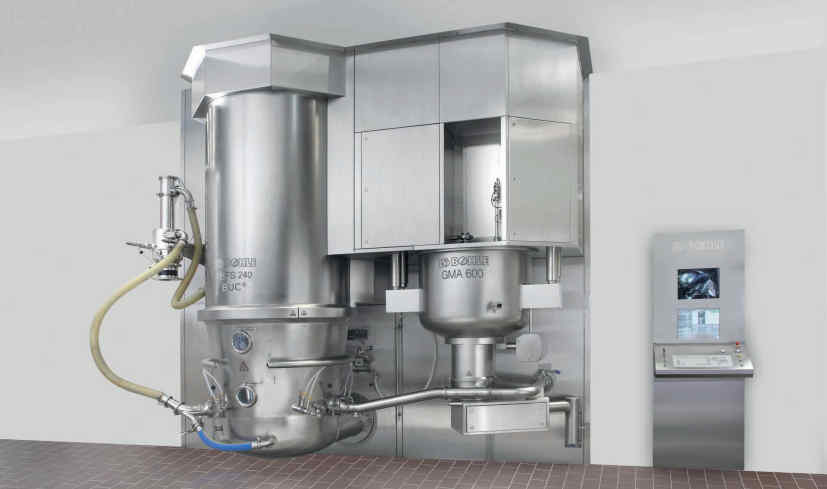
Batch wet granulation using a combined granulation line consisting of a high-shear granulator (GMA) and a fluid bed dryer (BFS) is the optimal technology for producing pharmaceutical solids. The integrated granulation plant combines high-shear granulation, fluid bed drying and sieving in one system. This minimizes individual process steps and interruptions. Integrating the process equipment does not alter the fundamental principles of wet granulation. However, the efficiency of the entire process increases. At the same time, the challenges associated with complexity are reduced.
An overview of the advantages of integrated granulation:
- Reduced space requirement(s) for GMP rooms
- faster production cycles
- closed product handling, improved industrial hygiene
- higher safety standards for equipment, personnel, premises, and environment
- common control platform and system integration
- improved GMP compliance
Wet granulation with Single Pot Granulation
Single-pot granulation combines mixing, high-shear wet granulation and drying by carrier gas, vacuum, or microwave, into a single-station process, all carried out within one process bowl. This granulation technology has various advantages, including efficiency, convenience, compact footprint, containment, and safety, that have for decades made it a favored solution for the pharmaceutical industry.
L.B. Bohle’s VMA range of Single Pot Granulators includes R&D systems for small production volumes as well as production-scale systems that can work alongside its other top-of-the-line granulation solutions such as BFS fluid bed systems, and BRC roller compactors. These technologies offer efficient, safe, and environmentally friendly production processes, perfect for manufacturing solid dosage forms in the pharmaceutical industry.
VMA Single Pot Granulator design and features
The VMA product range includes classic single-pot granulators with agitator and chopper units and a top drive. Twin stirrers produce the shearing action and loosen the product. This helps to prevent clumping and ensures that the resulting granules are of optimum quality. The double shell process bowl at the core of the VMA design offers very high containment levels and full GMP compliance.
The main aggregates are filled into the granulator through the port integrated into the upper lid of the top drive granulation pot. Processed granules are then emptied through a cone-shaped BTS 200 sieve via the floor outlet into an intermediate bulk container.
Recipe-controlled machine cleaning is carried out automatically after each batch, which can range from 20 to 960 litres in size, depending on VMA Single Pot Granulation model.
The high containment and vacuum process of the VMA design make it suitable for use in ATEX inflammable or explosive environments.
L.B. Bohle VMA Single Pot Granulation Benefits
The VMA Series of L.B. Bohle Single Pot Granulators offer pharmaceutical manufacturers a set of clear and tangible benefits that include:
- Safe production inside a closed bowl in a vacuum
- High mixing and granulation efficiency (even for low doses of active agents at below 1%)
- Low energy consumption: Drying at low temperatures
- Easy operation and cleaning, as well as quick product changes
- Efficient solvent recovery through cooling water
- Compact footprint with potential for through-wall mounting.
Efficient Tablet Coating Technology
Tablets are the most important oral dosage form in the pharmaceutical industry. Pharmaceutical film coating, which involves spraying a thin film of one or more polymers (and usually other functional excipients such as colour pigments or surfactants) that can perform a variety of functions onto the tablet, is now an important process step in the pharmaceutical industry.
The quality requirements for coated tablets can also be varied, depending on the purpose of the coating. The simplest coatings require only a small minimum thickness. These are, for example, swallowing aids or simple taste and odour masking, and the coating is often colourless. Coating uniformity within a batch is of secondary importance.
Cosmetic coating, where the tablet is coloured with a pigment or dye, is the next level of complexity. The main arguments for cosmetic coating are compliance, prevention of medication errors and marketing. The quality requirements are that the tablets should be uniform within a batch and between batches, with low surface roughness and sometimes high gloss (depending on the market).
In the case of delayed-release tablets, the thickness of the coating must be thicker than that of swallowable tablets. Furthermore, the tablets must be coated with a high degree of uniformity, as disintegration and release tests in various media must be passed within narrow limits according to pharmacopeial requirements.
Coated tablets used to control the sustained release of active ingredients and tablets coated with medicinal substances are the most demanding in terms of coating quality. Very high uniformities must be achieved, otherwise the complex release profiles cannot be reproduced.
As can be seen from the introduction, the coating process is a very complex one, in which the individual process steps must be precisely coordinated.
Harmonized process
Successful film coating processes must combine basic operations: spraying of coating suspension, drying, and mixing to ensure uniform distribution. Each individual production step must be carefully planned and optimized in harmony with the others.
In the BTC Tablet Coater, a flat tablet bed with a long pan geometry ensures the optimal flow of the tablet cores. The systematic forced guidance in the pan keeps the load in constant motion. This prevents twinning and minimizes loss of solids and coating to very low levels.
Novel concepts for both process management and cleaning improve the functionality of the tablet coater and produce outstanding results.
The air flow design unlocks clear process advantages, eliminating risk of spray-drying the suspension, reducing spray losses, and improving coating texture.
Gentle tablet handling
The pan geometry in combination with the mixing elements guarantees the gentle handling of the tablets. By reversing the rotational direction of the pan, the tablets can be emptied out quickly and completely.
In addition, in the Bohle Tablet Coater, all nozzles are supplied with suspension fluid via a single pump head.
Distinctive features of the BTC Series include ultra-functional easy to clean housing, designed for ‘through-the-wall’ installation, with built-in control cabinet incorporating multi-panel display with operator touch panel to make the machine easy to control and monitor.